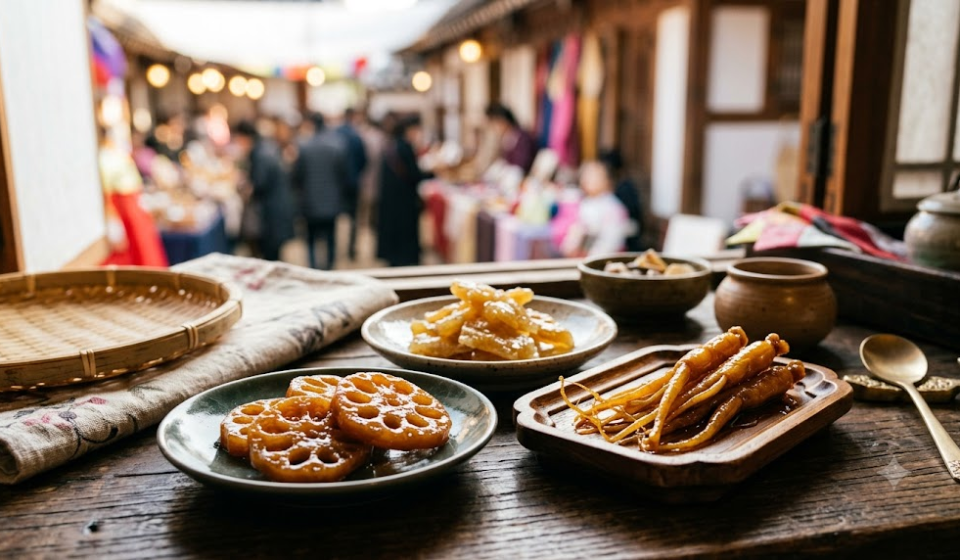

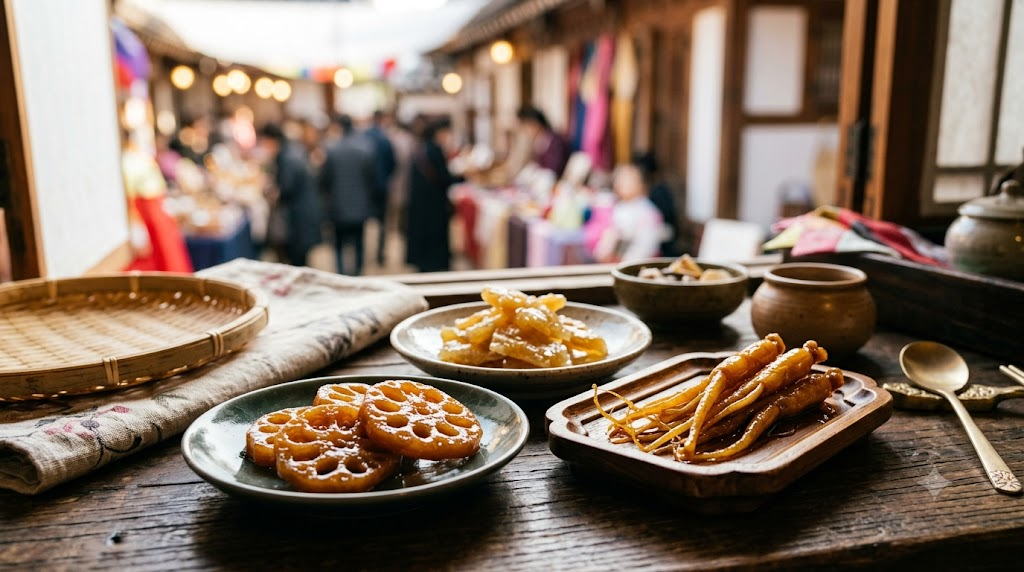
Before a holiday, a traditional food counter may display yeongeun-jeonggwa, saenggang-jeonggwa, and insam-jeonggwa side by side. Lotus root, ginger, and ginseng are not what we usually call fruit, yet all of these names end in “jeonggwa.” That makes the “gwa” part of the name worth a second look.
They do not all look alike on the plate, either. Lotus root often keeps its familiar shape, while ginger may be thinly sliced and ginseng may be candied whole. They are still grouped under the same name, jeonggwa. This is why the meaning of jeonggwa does not fit neatly into the simple idea of “a sweet made from fruit.”
Why lotus root jeonggwa and ginger jeonggwa share the same name
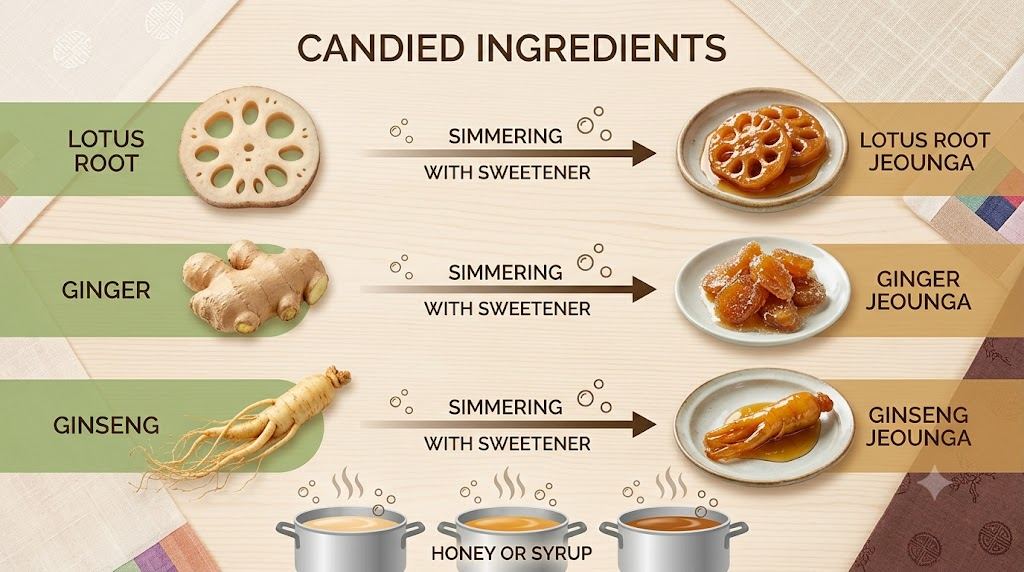
Jeonggwa refers to a traditional kind of sweet made by soaking or simmering ingredients such as nuts, root vegetables, and fresh produce in honey or sugar. The National Institute of Korean Language’s Onyong-eo resource also describes it as a sweet made by preserving or simmering various fruits, ginger, lotus root, carrot, ginseng, and similar ingredients in honey or sugar.
With that in mind, the word placed before jeonggwa usually tells you the main ingredient. Lotus root becomes yeongeun-jeonggwa, ginger becomes saenggang-jeonggwa, and ginseng becomes insam-jeonggwa.
Fruits such as quince, citron, and pear were used, but the ingredients did not stop there. Root vegetables such as lotus root, ginger, and radish, as well as ginseng and hawthorn, were also made into jeonggwa. If the “gwa” in the name is limited only to the modern meaning of “fruit,” names such as ginger jeonggwa and lotus root jeonggwa can seem oddly matched.
It is written 正果, but does it mean “proper fruit”?
Jeonggwa is written with the Chinese characters 正果. 正 means “correct” or “proper,” and 果 means “fruit,” but reading the name literally as a food meaning “proper fruit” does not match what jeonggwa actually is.
Older names offer another clue. According to the Encyclopedia of Korean Culture, jeonggwa was also called jeongwa (煎果), and versions simmered in honey were also known by the name miljeongwajeong (蜜煎果飣). The character 煎 carries the sense of simmering or cooking down, so the name jeongwa gives a clearer hint about the cooking method.
What can be confirmed is that the name jeonggwa used the characters 正果, while other names such as jeongwa and miljeongwajeong were also passed down. There is no firm evidence that explains in one clear story why the spelling 正果 became established.
It looks like a holiday food, but it appeared on more than holiday tables
When people think of jeonggwa today, holiday tables and traditional tea settings often come to mind first. In older table settings, however, jeonggwa was not limited to holiday meals.
The Encyclopedia of Korean Culture notes that jeonggwa was also used on jangguksang, large ceremonial tables, and ancestral rite tables. Because seasonal ingredients were preserved or simmered in honey, the method provided sweet snacks while also allowing ingredients to be kept for longer.
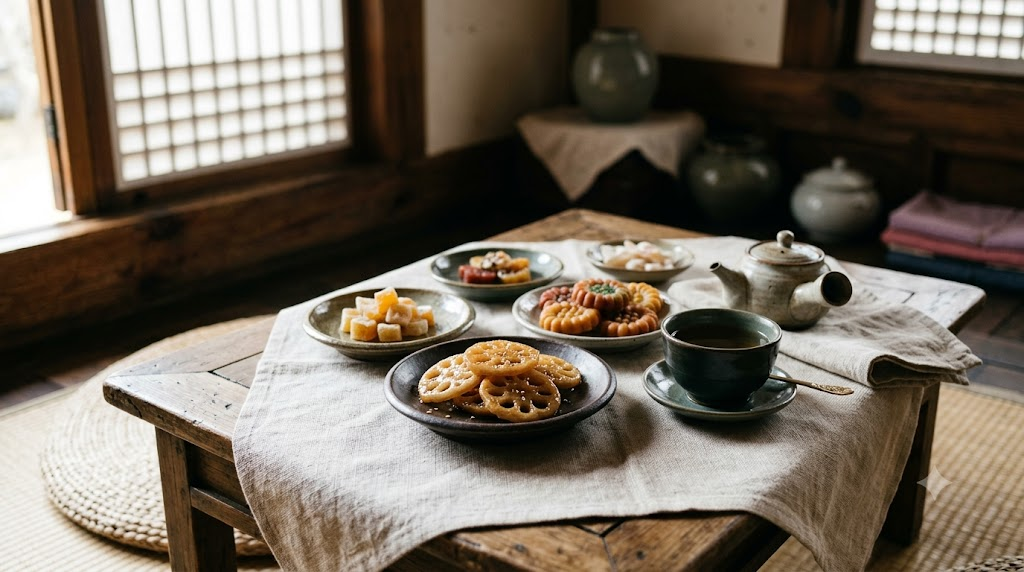
That does not mean a specific item such as lotus root jeonggwa or ginseng jeonggwa was served in every household on every holiday. Ingredients and table customs varied by period, region, and household, and there were many kinds of jeonggwa.
The sweet liquid left from making jeonggwa was also used
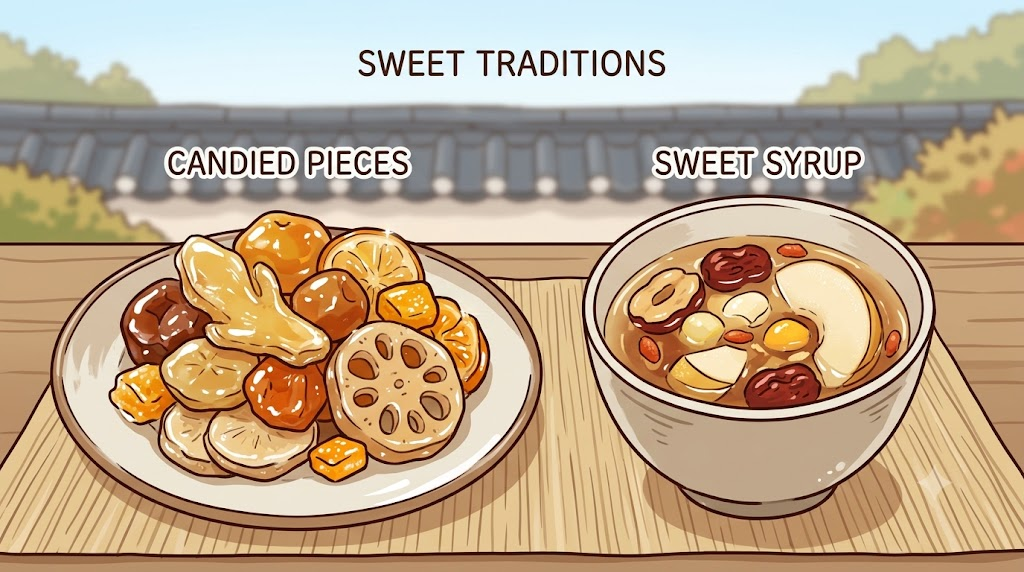
Jeonggwa can sometimes feel similar to fruit cheong. Both can involve soaking ingredients in honey or sugar, but with jeonggwa, the simmered pieces themselves are often eaten as sweets. Lotus root that keeps its ring shape and pieces of ginger served as they are are typical examples.
Some older sources also connect jeonggwa with sujeonggwa. Pieces of jeonggwa that had been soaked or simmered in honey were sometimes floated in honey water and enjoyed as a drink. Today, sujeonggwa usually brings dried persimmon, ginger, and cinnamon to mind, but older versions could also make use of jeonggwa.
As with the sweet liquid produced while making citron jeonggwa, the solid pieces and syrup could appear together. So even though “cheong” and “jeonggwa” can overlap in parts of the preparation, the names do not place emphasis on the same thing. With jeonggwa, the sweetened and simmered ingredient itself stands out as the item served on the plate.
How to read “ingredient name + jeonggwa” on products today
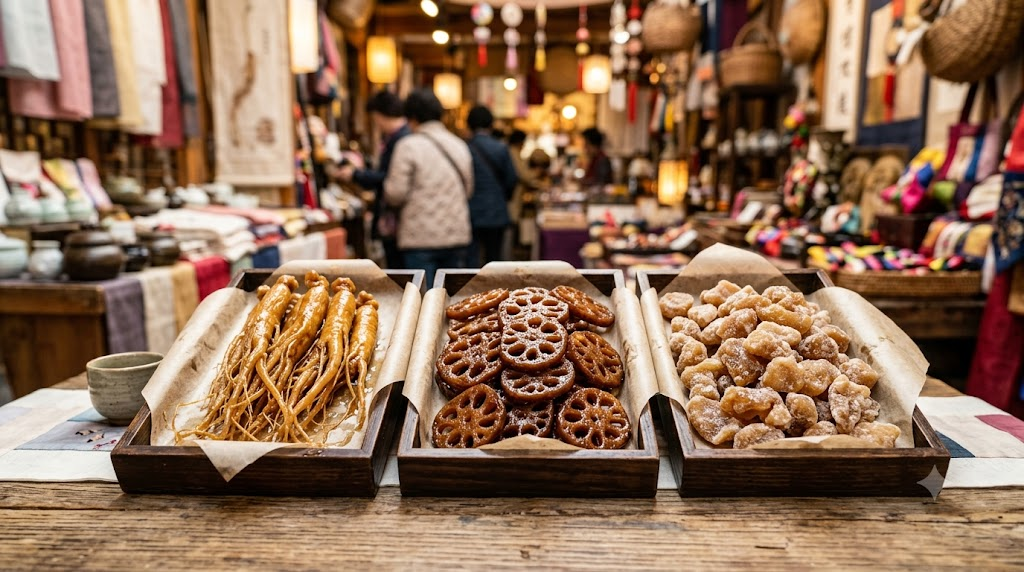
Among products sold today, names such as insam-jeonggwa, yeongeun-jeonggwa, and saenggang-jeonggwa are familiar. The first part tells you which ingredient is used, while “jeonggwa” suggests a traditional sweet made by soaking or simmering that ingredient in a sweet syrup.
Even two lotus root jeonggwa products do not have to look exactly the same. Some remain moist with syrup, while others are dried after simmering and have a drier surface. The product name tells you the ingredient and the food type, but it does not define one exact level of moisture or texture.
So when choosing jeonggwa in a holiday gift section, it is quicker to check the ingredient named first and then look at the product photo or description to see how it was simmered and finished. The word “jeonggwa” alone does not tell you whether the texture will be moist or dense and chewy.
The meaning of jeonggwa points more to the preparation than to one ingredient
The meaning of jeonggwa is best understood as a traditional kind of sweet made by soaking or simmering nuts, root vegetables, fresh produce, and other ingredients in honey or sugar, rather than a name limited only to fruit. Along with the Chinese-character spelling 正果, older names such as jeongwa (煎果) and miljeongwajeong (蜜煎果飣) are also recorded.
So there is nothing unusual about seeing ginger jeonggwa and lotus root jeonggwa side by side on a holiday table or at a traditional market. Different ingredients are placed under the same name, “jeonggwa,” because they share the method of being sweetened or simmered and served as traditional refreshments.
※ This content is provided as a reference for food names and food culture.
※ Food origins, regional names, and preparation methods may be passed down differently depending on sources, regions, households, and restaurants, so please also refer to official materials and actual menu information.